Variant management has a reputation problem
Variant management has a reputation problem. Most people either think it’s hopelessly complex, or they reduce it to a single tool like CPQ. Neither is right — and both misconceptions cost companies real money. Here are five myths worth busting.
Many variants = complex
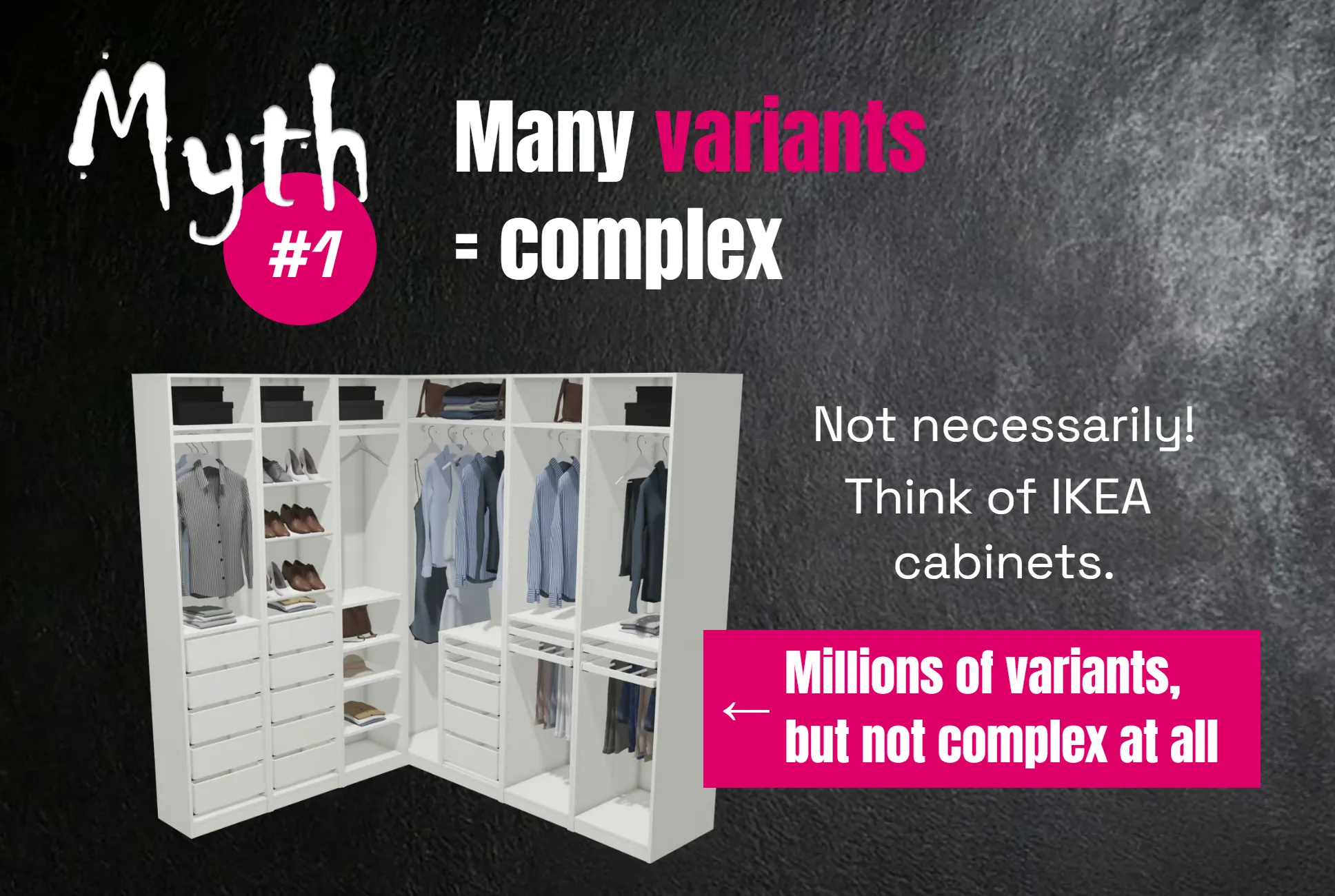 It’s easy to assume that more variants automatically lead to more complexity, but that’s not always the case.
Take IKEA’s modular cabinets: there are millions of possible configurations, but the underlying system is standardized and cleverly designed. The real trick is in the architecture: if you build your variant logic on a simple, modular foundation, you can offer vast choice with minimal chaos.
Complexity Complexity (kəm-ˈplek-si-tē) n. In variant management, complexity reflects the effort needed to master customer variety, product variants, and their lifecycle processes. Learn its key dimensions. is less about the number of variants and more about how you structure and manage them.
Few variants = simple
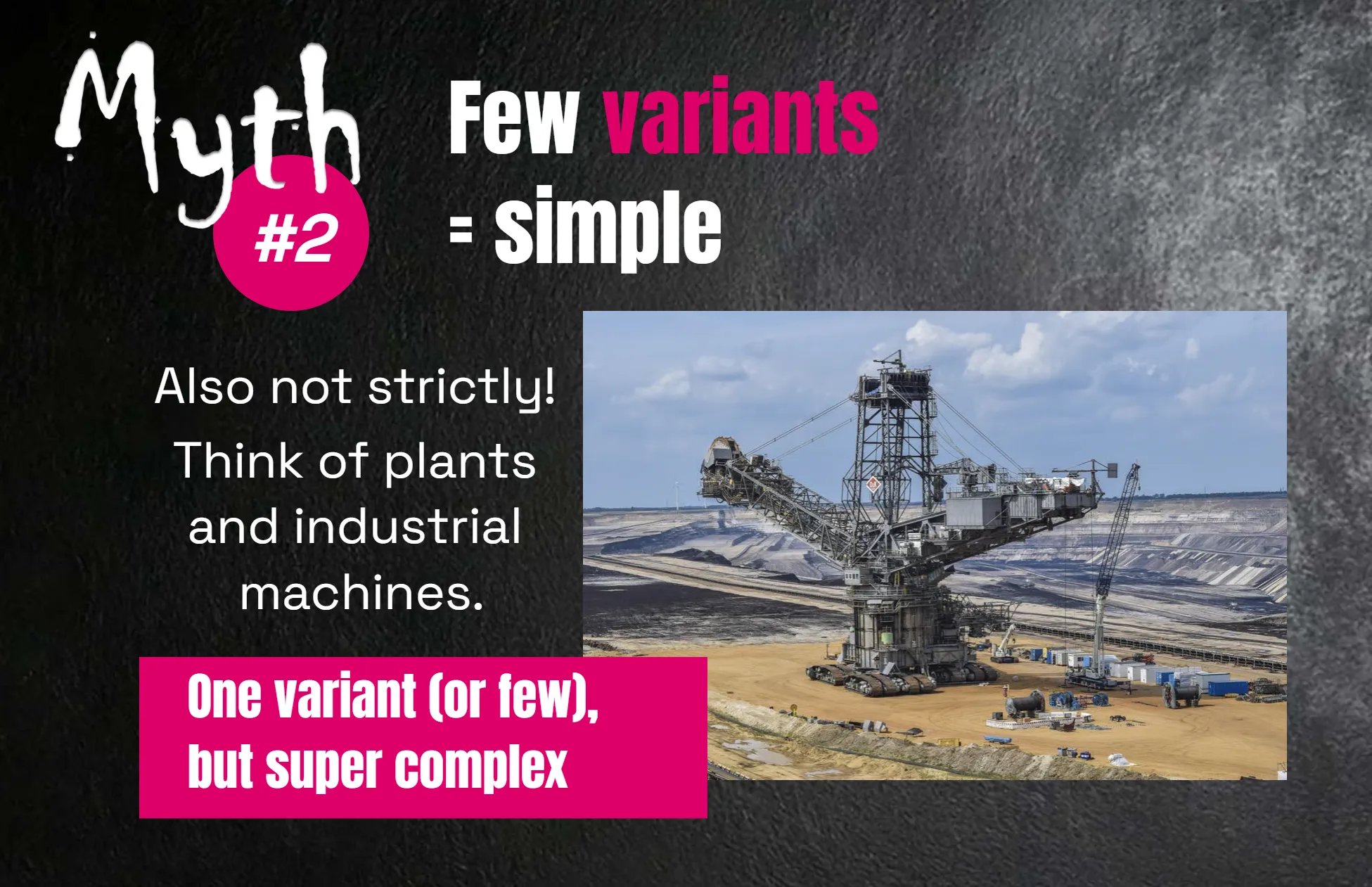 Fewer variants don’t automatically mean things are easy.
Sometimes, even a single product variant can be a technical marvel — just look at a power plant or a giant excavator. Here, the complexity is embedded in the product itself, not in the number of options.
In these cases, the challenge is managing the intricate details, interfaces, and requirements, even if you’re only building one or two “variants.”
Variant management is only about the product
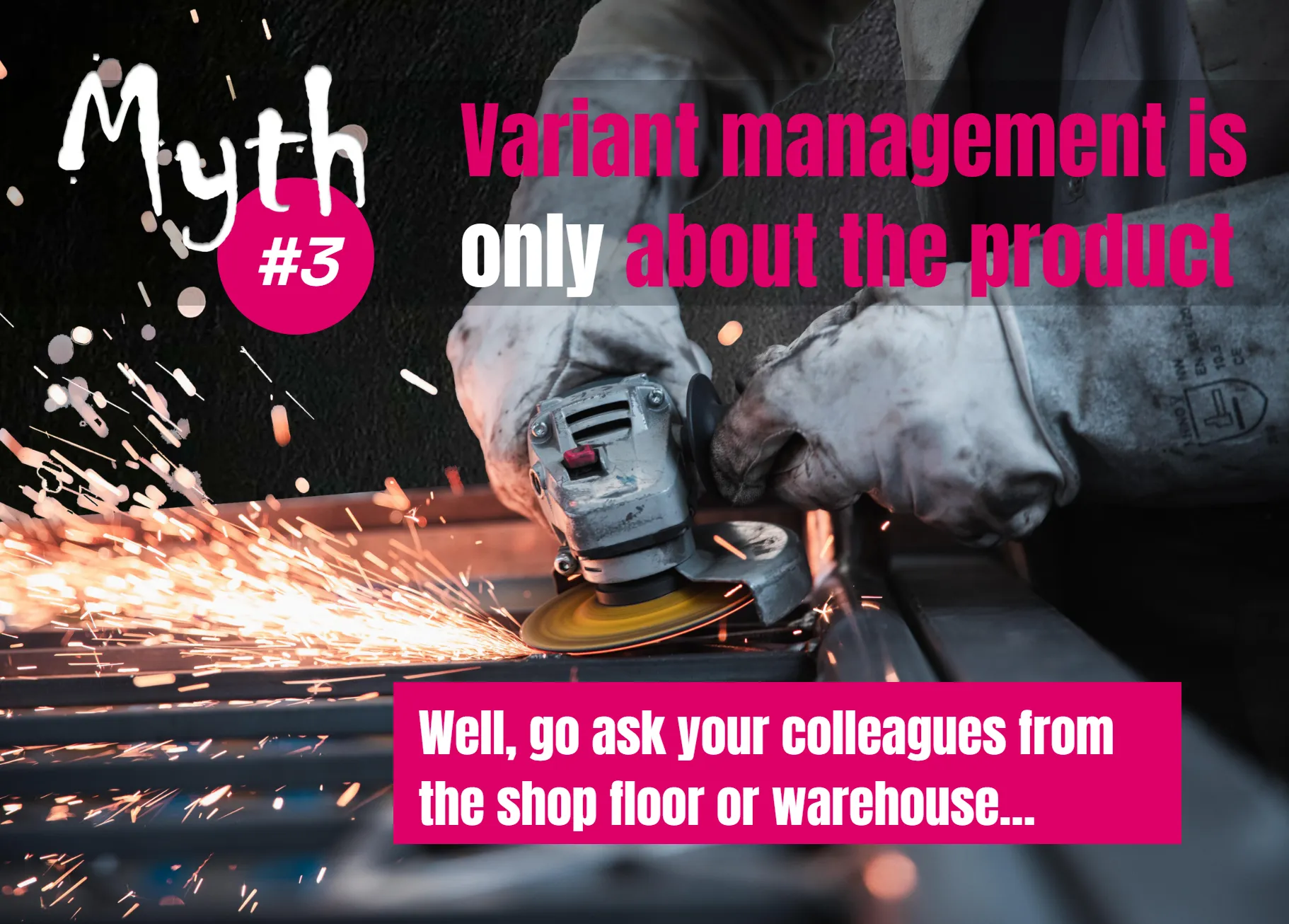 Variant management isn’t just a design or engineering topic.
Every variant decision ripples through the entire organization: from the shop floor to logistics and aftersales. A new variant can mean new tooling, different storage requirements, or updated service manuals. Ignoring these downstream effects can cause headaches for everyone involved.
Effective variant management takes the whole value chain into account.
Variant management = CPQ
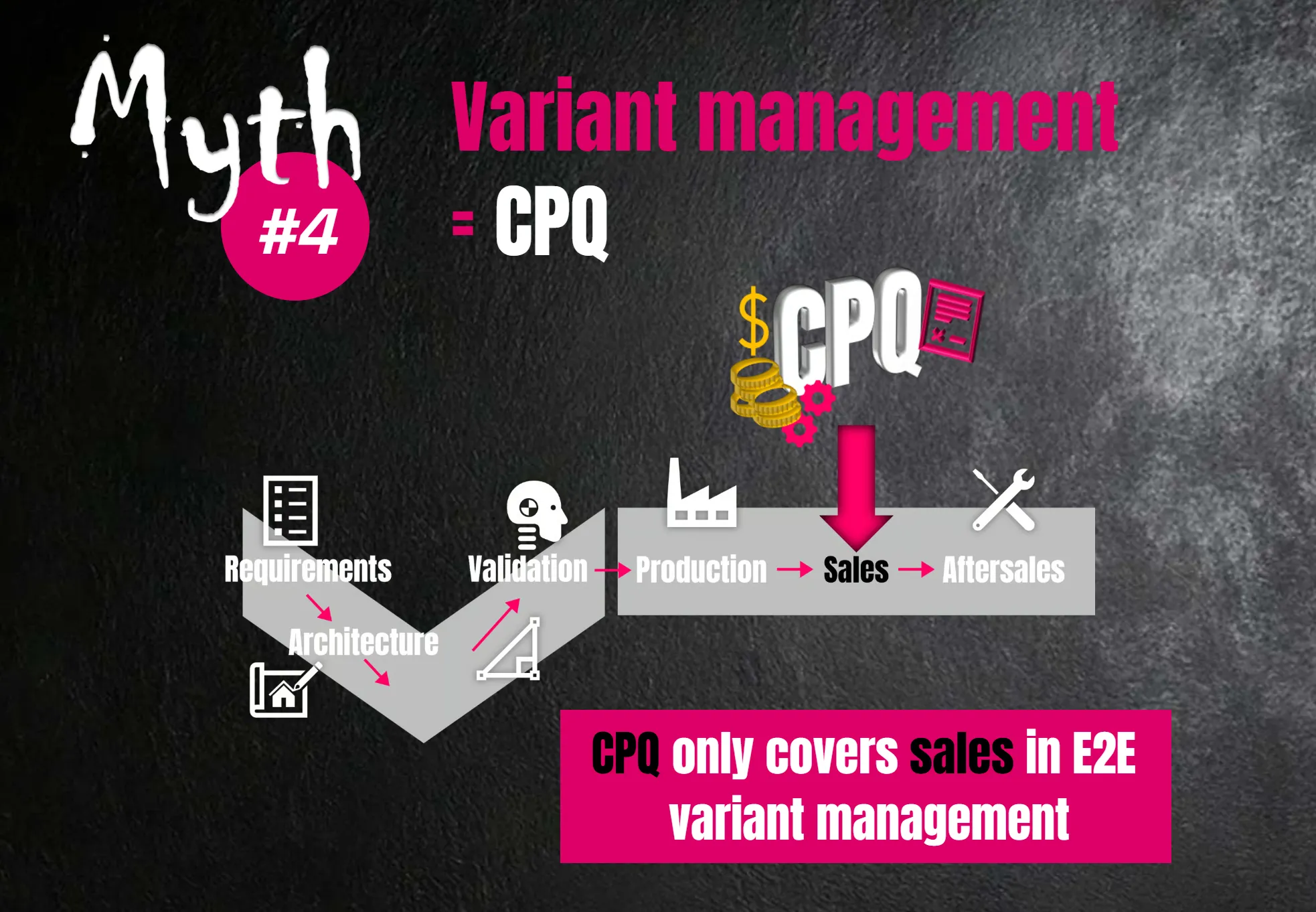 CPQ (Configure, Price, Quote) CPQ – Configure, Price, Quote (ˌsē-ˌpē-ˈkyü) n. abbr. CPQ stands for Configure, Price, Quote — software that automates sales quoting for configurable products by enforcing product rules, calculating pricing, and generating output. is a great tool for sales, but it’s just one piece of the variant management puzzle.
True end-to-end variant management covers everything from capturing requirements and designing product architecture Product Architecture (ˈprä-dəkt ˈär-kə-ˌtek-chər) n. Product architecture defines how a product is decomposed into functional and physical elements and how those elements interact — a key decision in variant management strategy. to validating, producing, and servicing those variants. Limiting the discussion to CPQ ignores the critical steps that ensure variants are feasible, manufacturable, and maintainable.
Versions don't count in variant management
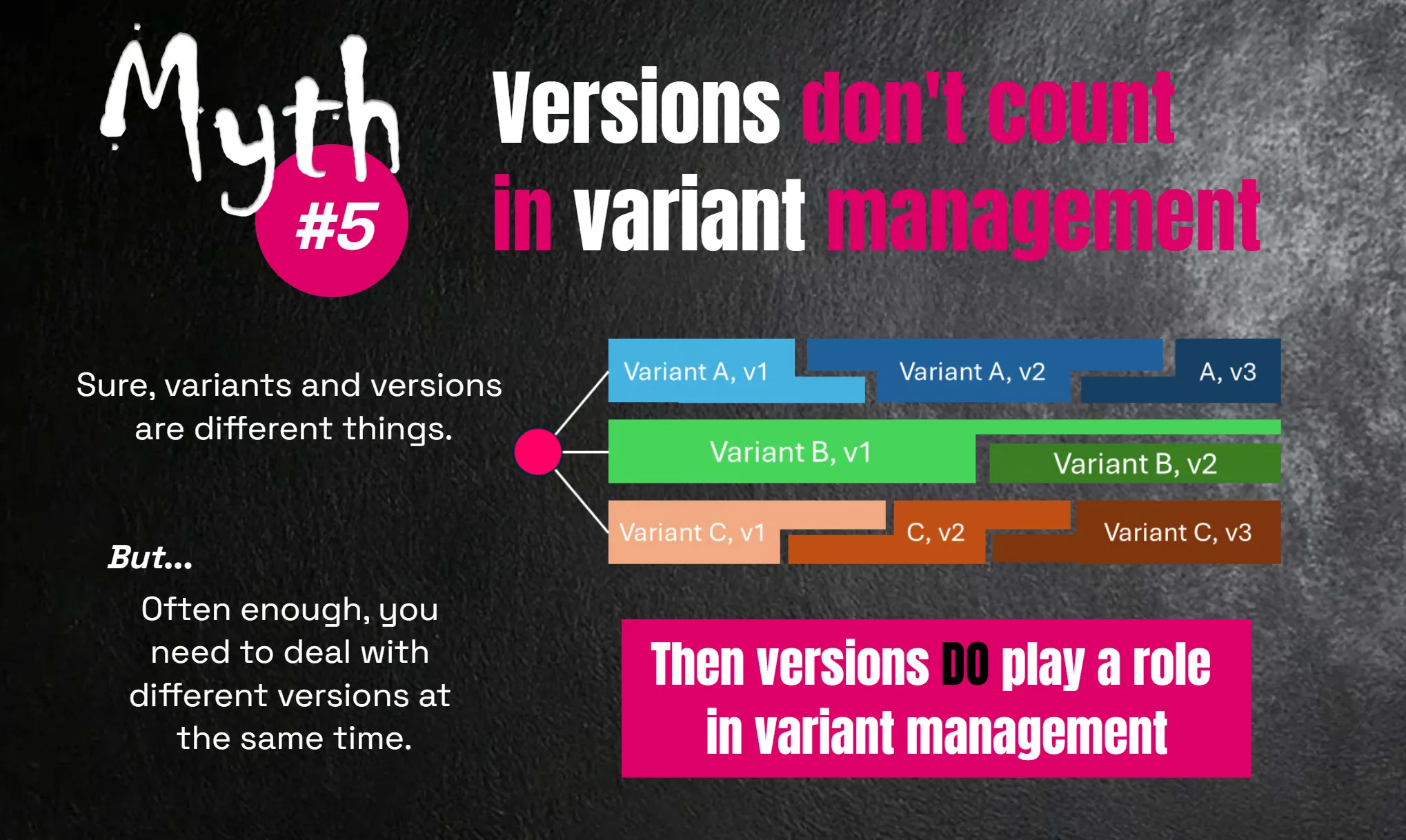 Sure, variants and versions are different things. But…
While variants and versions are technically distinct — variants describe different options, versions track changes over time — they often intersect in practice. You might need to support multiple versions of a variant during a transition period or for different markets.
Good variant management recognizes when version control is needed to keep everything running smoothly, especially in complex product lifecycles.
The bottom line
Most variant management problems don’t start with too many variants — they start with the wrong questions. Companies that ask “how many variants do we have?” tend to end up counting. Companies that ask “how well is our variant architecture designed?” tend to end up in control.
The five myths above share a common root: they all reduce variant management to a single dimension — a number, a tool, a department, a product. In reality, it’s a discipline that connects requirements engineering, product architecture, manufacturing, logistics, and aftersales. No single team owns it, and no single tool solves it.
That’s not a reason to despair. It’s a reason to start earlier, involve more stakeholders, and build for the whole lifecycle — not just the next sales quote.
Frequently asked questions
Does more product variants always mean more complexity?
Not necessarily. The number of variants is less important than how they are structured. A well-designed variant architecture — based on modular platforms, standardized interfaces, and clear configuration rules — can support millions of valid combinations with manageable internal complexity. IKEA’s furniture system is a classic example: an enormous option space built on a surprisingly small set of standardized components. Complexity tends to explode not when variant counts grow, but when the underlying architecture lacks discipline.
Can a product with only one or two variants still be complex to manage?
Absolutely. Variant count and product complexity are independent dimensions. A single product variant — such as a custom power plant, a large industrial machine, or a complex defense system — can involve thousands of interdependent components, highly specific customer requirements, and intricate engineering constraints. In these cases, variant management is less about offering choices and more about controlling the product’s internal complexity, tracking requirements precisely, and ensuring every configuration is valid and producible.
Why does variant management affect logistics and manufacturing, not just engineering?
Every variant decision made in engineering eventually becomes a physical reality somewhere else in the organization. A new color option means new paint stock in the warehouse. A new drive variant means new tooling on the shop floor. A new regional configuration means updated service manuals and spare parts catalogs. If logistics, production, and aftersales teams are not involved early, variant decisions can create downstream bottlenecks and costs that were never anticipated during the design phase. Effective variant management treats the entire value chain as a stakeholder.
What is the difference between CPQ and end-to-end variant management?
CPQ (Configure, Price, Quote) is a sales-facing tool that helps customers and sales teams navigate a product’s option space, validate combinations, and generate quotes. It operates at the point of sale and relies on variant rules that must already be defined, validated, and maintained upstream. End-to-end variant management covers the full lifecycle: capturing customer requirements, designing the product architecture, defining valid variant rules, validating feasibility in engineering, controlling variant data across PLM and ERP systems, and managing variants through production, service, and end-of-life. CPQ is the visible tip; variant management is everything beneath it.
What is the difference between product variants and product versions?
Product variants describe different options or configurations that exist simultaneously in the market — for example, a machine available in three power levels or two regional specifications. Product versions describe how a specific product or variant changes over time — for example, a series of engineering changes applied to the same model over its lifecycle. The distinction matters because the two require different management approaches: variants are primarily a configuration challenge, while versions are primarily a change management challenge. In practice, they frequently overlap: a product in market transition may have multiple versions of the same variant active at the same time.
How do I know if my organization has a variant management problem?
Common warning signs include: engineering spending significant time answering “is this combination valid?” instead of developing new products; sales teams relying on tribal knowledge to configure orders correctly; production encountering last-minute surprises when customer orders arrive on the shop floor; aftersales struggling to identify which spare parts apply to which delivered product; and a product portfolio that has grown steadily but whose profitability per variant has declined. If any of these ring true, the underlying issue is usually not the number of variants but the lack of a structured, organization-wide approach to managing them.